Hybrid System Design & Analysis on ETAP
Last update: May/12/2026 by Di Wang
This project aims to enhance my learning and understanding on:
- Power system deisgn
- System engineering work flow
- ETAP software
The learning note of ETAP is summarized in another page.
This project is processed under the system engineering workflow from requirements, to general conceptual design, to detailed system design on ETAP, and finally to the verification system simulation and analysis.
Requirements:
- Design a hybrid power system with different types of renewable energy sources
- The energy demand of the loads at peak time is 10MW
- A low-carbon microgrid is needed
- In ideal strong wind scenarios, the wind turbine farm alone can supply the demand of the entire loads
- The PV panel array is needed to act as the extra supply of the wind farm
- The extra energy generated from renewable resources can be stored for future use
Conceptual design:
- Apply wind turbines farm, PV array as renewable sources
- A Battery Energy Storage System (BESS) is applied to utilize the extra energy
- The utility grid should be connected for stable energy supply and net zero purpose
- The different cases are considered:
- Case 1: power demand from the loads is less than the power generated from renewable resources
- Wind farm, PV array, and possibly battery are supplying the energy to the loads
- The extra power generated from the renewable sources charge the battery and flow back to the grid
- Case 2: power demand from the grid is greater than the power generated from renewable resources
- renewable resources supply the loads
- grid supplies the deficit
- Case 3: no power generated from renewable sources (no wind, no sunlight)
- battery discharge to supply the loads
- external grid utility as the main power supplier to the loads
- Case 1: power demand from the loads is less than the power generated from renewable resources
- The power system will be designed on ETAP platform with proper configuration for each element
- The corresponding analysis will be performed to verify the power system
Detailed design (ETAP):
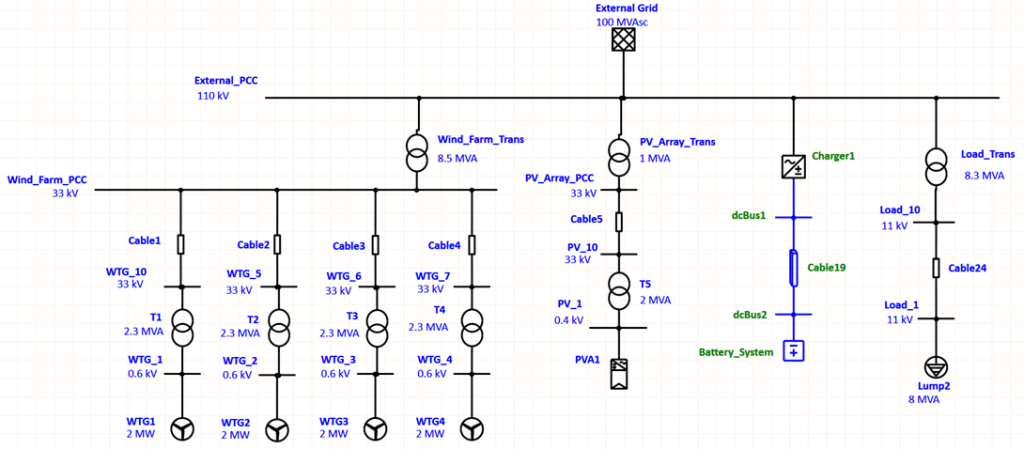
- Based on the above description, the power system design shall match the requirements and conceptual design. The below content describes the detailed info of the hybrid power system that combines wind turbines, PV array, BESS, loads and a external grid.
- Utility power grid:
- 110kV rated voltage
- 3-phase 100MVAsc fault power. The short circuit current can be calculated: Isc = 0.5kA
- X/R ratio for the grid is set as 7
- Wind turbine configuration:
- the wind farm contains 4 wind turbines totally
- for each wind turbine, the rated active power is 2MW. So, the wind farm contributes 8MW real power totally
- PV array configuration:
- The solar PV panel: SUNTECH STEP180s
- PV array: 50 by 20 solar panel array with 179W power rating for each panel
- BESS configuration:
- The system contains internal inverter that converts DC power to AC
- the selected battery group has total capacity 552AH
- the total battery group has 600 battery cells in total with 2V for each
- above, the total energy the battery group can store is around 0.7MWh, it means the stored energy from the battery group can supply the loads about 4.5 minutes when there has no power input from renewable sources or utility at all.
- Utility power grid:
- The power system configuration on ETAP is shown below:
Simulation and analysis:
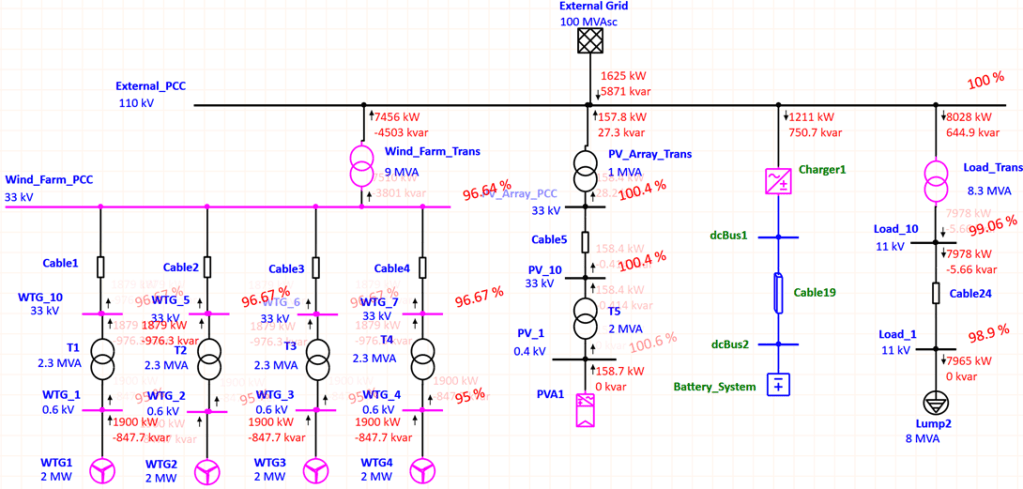
- Running load flow analysis first to ensure the power system is running properly. The simulation result is shown below, and there has no alert happens:
- Transient stability analysis: to check if the system can remain stable after a fault or fast dynamic event. In this analysis, the below event is simulated:
- The short circuit fault happened on external PCC bus bar at three second, and the fault will be cleared within 0.2 seconds at 3.2 second. The simulation result is shown below:
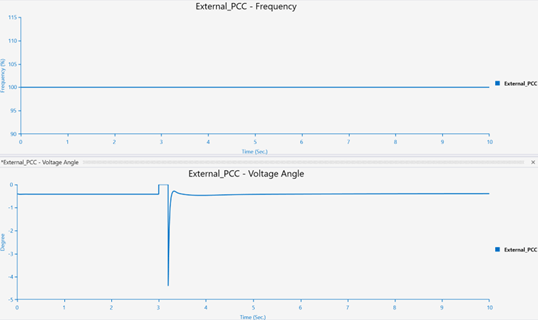
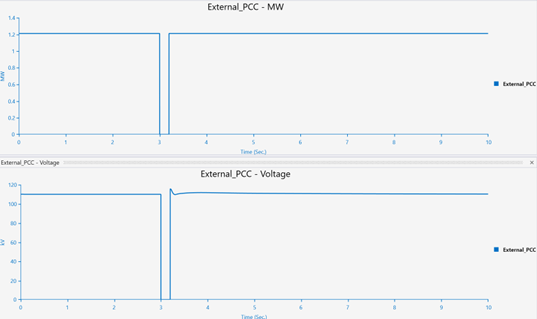
- From the results: the frequency remains stable even there has a fault occurred; both voltage and active power dropped to zero due to the fault, and they then recovered to pre-disturbance values after the fault is cleared; and voltage angle also indicate the good synchronism and good damping capacity of the power system from oscillaiton.

